Essential Tips for Choosing the Right Heat Flow Rate Sensor?
Choosing the right Heat Flow Rate Sensor is crucial for accurate thermal management. These sensors measure heat transfer rates in systems. Their precision impacts energy efficiency and system performance.
Understanding the various types of heat flow sensors is important. Some are designed for high temperatures, while others excel in specific applications. Each sensor has unique characteristics that may not suit every situation. It's essential to consider your project requirements carefully.
Furthermore, proper installation and calibration of the Heat Flow Rate Sensor significantly affect data reliability. Lack of attention to detail can lead to inaccurate readings. Therefore, manufacturers often provide guidelines, but real-world applications may yield unexpected challenges. Embracing these complexities can enhance your expertise and decision-making skills.
Understanding Heat Flow Rate: Definitions and Importance
Heat flow rate is crucial in various industries, especially in building energy management and thermal efficiency assessments. It measures how much heat energy passes through a surface over time. Understanding its importance can improve energy conservation strategies, enhance comfort, and reduce operational costs. According to the International Energy Agency, optimizing heat flow can lead to energy savings of up to 30% in residential buildings. This emphasizes the need for accurate heat flow rate sensors.
Choosing the right heat flow rate sensor is essential. Look for sensors with high accuracy and sensitivity. Make sure they can operate in diverse environmental conditions. Some sensors are better suited for stationary applications, while others excel in dynamic environments. It's important to assess the specific needs of your project before making a choice.
Consider data from the American Society of Heating, Refrigerating and Air-Conditioning Engineers. Their studies show that the integration of proper heat flow measurement tools significantly enhances system performance. This highlights the value of reliable sensor data. Always check for certifications and testing standards to ensure you’re selecting a sensor that meets industry benchmarks.
Key Parameters to Evaluate in Heat Flow Rate Sensors
When selecting a heat flow rate sensor, several key parameters should guide your decision. First, accuracy is crucial. A sensor needs to provide precise measurements to ensure reliable data for your applications. Look for specifications that indicate the sensor's measurement error. This can range from a few percent to less than one, depending on the technology employed.
Sensitivity is another important factor. A sensor should detect even the slightest changes in heat flow. This is especially relevant in applications such as thermal management systems. However, higher sensitivity can sometimes come with increased susceptibility to environmental noise. Understanding this trade-off is essential.
Additionally, consider the range of the sensor. Some applications may require measurements at both high and low heat flow rates. Compatibility with your system also matters. Evaluate how easily the sensor integrates with existing technology. Always reflect on your specific needs and situations. Too often, users overlook these finer points, leading to poor performance and data quality.
Essential Tips for Choosing the Right Heat Flow Rate Sensor
| Parameter |
Description |
Importance |
Typical Values |
| Temperature Range |
The operational temperature limits of the sensor |
Ensures accuracy within desired temperature applications |
-40°C to 200°C |
| Sensitivity |
The minimum heat flow that can be detected |
Critical for applications requiring precise readings |
0.1 mW/m² |
| Response Time |
Speed of the sensor's response to changes in heat flow |
Important for dynamic applications where quick changes occur |
< 1 second |
| Accuracy |
Degree to which the sensor's output agrees with the actual value |
Essential for reliable measurement in critical applications |
±1% |
| Calibration |
The process of adjusting the sensor to ensure accurate readings |
Necessary for maintaining sensor reliability over time |
Annual calibration recommended |
Comparison of Sensor Types: Thermocouples vs. Resistance Sensors
When selecting a heat flow rate sensor, it's crucial to understand the available types. Thermocouples are popular due to their wide temperature range and rapid response time. They can operate from -200°C to 2000°C, making them ideal for diverse environments. However, they may suffer from accuracy issues, particularly at lower temperatures. A common industry report indicates that thermocouples can have an accuracy range of ±1°C, which may not be sufficient for critical applications.
Resistance sensors, or RTDs, offer higher accuracy. They maintain a consistent output over a narrower temperature range, typically from -200°C to 850°C. A report published by the American Society of Mechanical Engineers noted that RTDs can achieve an accuracy of ±0.1°C in controlled conditions. Yet, their slower response time can be a drawback in dynamic applications.
Additionally, environmental factors play a significant role in sensor performance. Both types can be influenced by humidity and electromagnetic interference. Understanding these challenges is key to making an informed choice. Selecting the right sensor requires careful consideration of application-specific needs and potential limitations. Balancing accuracy with response time is not always straightforward, and the needs of your project should guide your decision.
Calibration Standards and Accuracy in Heat Flow Rate Measurement
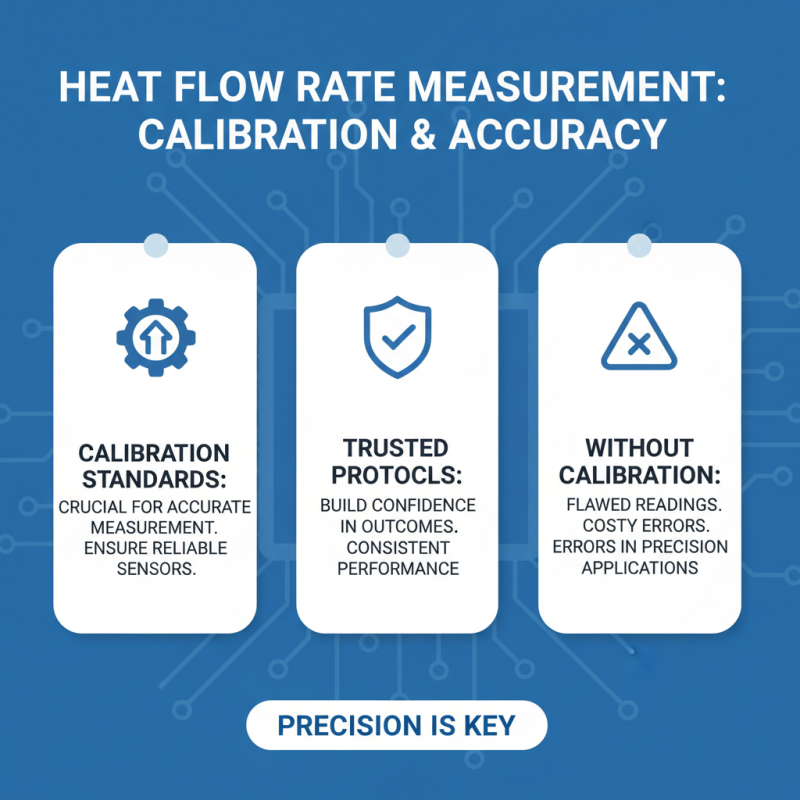
Calibration standards are crucial for accurate heat flow rate measurement. These standards ensure that sensors are reliable and perform consistently. Working with recognized calibration protocols builds trust in measurement outcomes. Without proper calibration, readings may be flawed. This can lead to costly errors in applications where precision is key.
Accuracy in measurement affects many industries. Engineers, manufacturers, and researchers rely on precise data to make decisions. Inaccurate data can compromise project integrity. Regular calibration checks are essential. It encourages a routine assessment of sensor functionality, which can prevent long-term issues. Even experienced professionals can overlook the importance of calibration over time.
When selecting a heat flow rate sensor, consider the calibration history. A sensor with a strong calibration record enhances reliability. Pay attention to the conditions under which the sensor was calibrated. If those conditions differ significantly from your application, results may vary. Reflect on the implications this has on your work. Select tools that match your specific needs. Every choice counts, especially when precision shapes outcomes.
Application Areas: Industries Benefiting from Heat Flow Rate Sensors
Heat flow rate sensors play a crucial role in various industries. Accurate measurements influence energy efficiency and environmental impact. For instance, the construction industry relies on these sensors to manage energy use during projects. Data from the Global Energy Monitor indicates that buildings account for 39% of global CO2 emissions. By optimizing heat flow, construction managers can reduce this footprint significantly.
In manufacturing, heat flow rate sensors are vital for process control. They ensure products meet quality standards while minimizing energy waste. A report by the International Energy Agency highlights that improved heat management can save up to 10% of energy costs in high-temperature industrial processes. However, not all sensors provide reliable readings. Companies must consider factors like calibration and installation to avoid costly errors.
The automotive sector benefits as well. Efficient thermal management contributes to vehicle performance and comfort. According to the Society of Automotive Engineers, improper heat management can decrease efficiency by 15%. This emphasizes the need for precise heat flow rate sensors. With technology advancing rapidly, organizations must remain aware of sensor reliability and accuracy to sustain any competitive advantage.
Essential Tips for Choosing the Right Heat Flow Rate Sensor
This bar chart illustrates the application areas benefiting from heat flow rate sensors across various industries, showcasing the percentage of usage in each sector. This data highlights where the sensors are most impactful and can guide decision-making when selecting the appropriate sensor for specific applications.

 Sensor
 Measuring Instruments
 Measurement Systems
 Architectural Physics Laboratory