Top Tips for Choosing the Right Heat Flow Rate Sensor?
Selecting the right Heat Flow Rate Sensor is crucial for accurate thermal management. The market for these sensors is growing, driven by increased demand in industries such as automotive and building efficiency. According to a recent report by Frost & Sullivan, the global market for temperature sensors is expected to reach $3.4 billion by 2025, highlighting the importance of precision instruments.
Dr. Emily Chen, a renowned expert in thermal measurement, emphasizes, “Choosing the right Heat Flow Rate Sensor can significantly enhance energy efficiency and cost savings.” The implementation of high-quality sensors has shown to improve energy savings by up to 30% in HVAC systems. As industries become more energy-conscious, understanding sensor specifications will become essential.
In a world where precision matters, the choice of a Heat Flow Rate Sensor can affect product performance. Many decision-makers overlook critical factors, such as response time and calibration methods. It's vital to reflect on how each sensor aligns with specific project needs. A well-informed choice can prevent costly errors and enhance operational efficiency.
Understand the Basics of Heat Flow Rate Sensors and Their Applications
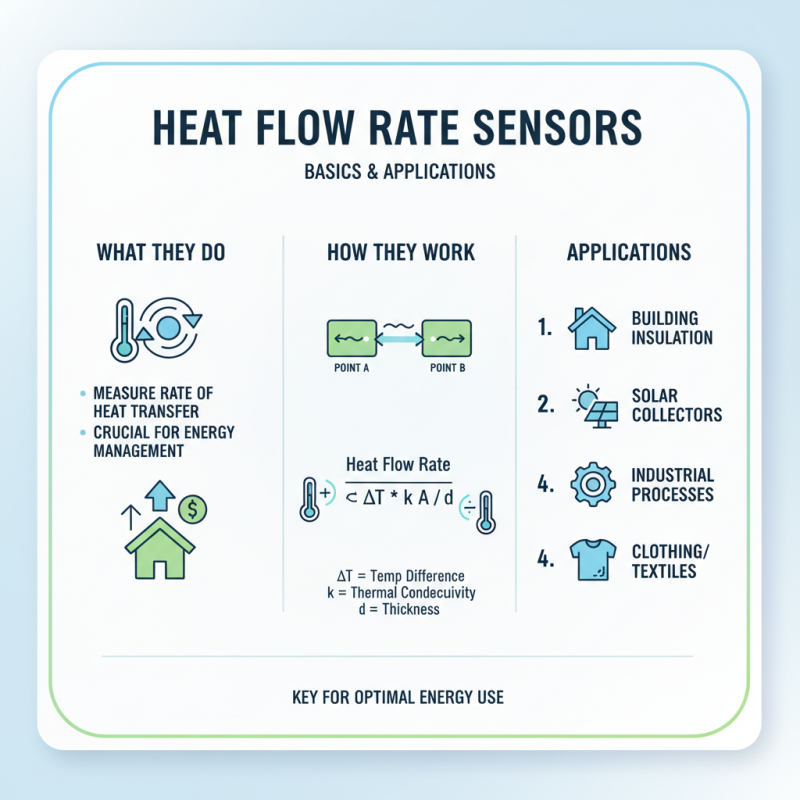
Heat flow rate sensors are essential in many industries. They measure the rate of heat transfer, which is crucial for energy management. Understanding how these sensors work is key to choosing the right one. The basic principle involves measuring the temperature difference between two points and the material's thermal conductivity.
According to a report by the International Energy Agency, accurate heat flow rate measurements can improve energy efficiency by 15-30% in industrial systems. This data highlights the importance of choosing the right sensor. Sensors vary in sensitivity, response time, and range. For example, some sensors can detect minute changes in temperature, which is vital for precise monitoring.
Real-world applications include HVAC systems, insulation testing, and thermal conductivity assessments. Each application may require different sensor characteristics. However, not all sensors perform well in every scenario. Some might struggle with extreme temperatures or in environments with fluctuating conditions. Failing to assess these factors may lead to inaccurate data and increased operational costs.
Identify Key Parameters for Measuring Heat Flow Rate Accurately
When selecting a heat flow rate sensor, understanding key parameters is essential. The accuracy of measurements greatly depends on the sensor's sensitivity, calibration, and response time. A sensor with higher sensitivity can detect smaller changes in temperature, providing more precise data. Calibration is crucial; an uncalibrated sensor may yield skewed results, leading to unreliable assessments.
Response time is another vital factor. Sensors that react swiftly can capture transient heat flows, crucial in dynamic environments. Slow sensors might miss important fluctuations, resulting in incomplete data. The environmental conditions where the sensor will be deployed should also be considered. Factors like pressure, humidity, and temperature range can affect sensor performance.
It’s essential to reflect on the specific application. Different applications may have unique requirements, influencing the choice of sensor. Sometimes, complexity in usage can arise. For instance, some sensors require intricate setups, which may complicate straightforward readings. Assessing these aspects will help ensure an effective selection that aligns with measurement goals.
Top Tips for Choosing the Right Heat Flow Rate Sensor
| Parameter |
Description |
Importance |
Typical Range |
| Sensitivity |
Ability of the sensor to detect small changes in heat flow. |
High |
0.1 - 10 W/m² |
| Temperature Range |
Operating temperature limits of the sensor. |
High |
-20°C to 100°C |
| Response Time |
Time taken by the sensor to respond to a change in heat flow. |
Medium |
1 - 10 seconds |
| Calibration |
Frequency and method for recalibrating the sensor. |
High |
Annual or as needed |
| Mounting Type |
How the sensor is attached to the measurement surface. |
Medium |
Point, Line, or Area |
Explore Different Types of Heat Flow Rate Sensors Available on the Market
When selecting a heat flow rate sensor, understanding the types available is essential. Numerous options can cater to various applications. Some sensors are designed for high-temperature environments, while others excel in low-temperature conditions. Each type varies in sensitivity and response time, impacting the overall efficiency of the system being monitored.
Among the popular types are thermopiles and thermocouples. Thermopiles are effective for measuring small temperature differences. They offer a decent response time but may fall short in extreme conditions. In contrast, thermocouples can withstand higher temperatures and provide quick readings. However, calibration can be tricky, creating potential inaccuracies if not handled correctly. It's vital to consider these factors when choosing the right sensor.
Integration with existing systems is another critical aspect. Some sensors require specific data loggers or interfaces, which may lead to increased costs. Testing and trial runs can uncover potential integration issues, which could affect overall performance. Therefore, conducting thorough research and consulting with experts is advisable. Gathering insights on the right sensor can save time and effort in the long run, ensuring efficient heat flow measurement.
Assess Sensor Accuracy and Calibration Standards Used in the Industry
When selecting a heat flow rate sensor, accuracy is paramount. It is essential to assess how well a sensor can measure thermal energy transfer. This involves looking at its calibration standards. High-quality sensors comply with industry standards, ensuring they produce reliable data. Calibration establishes a reference point. It verifies whether a sensor’s readings are accurate, allowing engineers to make informed decisions.
Moreover, different industries may require specific calibration protocols. Some sensors might be calibrated using established methods, while others may not adhere to rigorous practices. This discrepancy can impact the sensor's reliability. Users must verify the calibration certifications. Regular calibration checks enhance sensor performance and maintain accuracy over time.
Installation can also affect sensor output. A poorly installed sensor might yield erroneous results, even if the device is highly accurate. It's crucial to follow manufacturer guidelines in the installation process. Sensitivity to environmental factors, such as humidity and temperature, warrants consideration. Regular maintenance helps identify issues early, helping ensure the sensor performs effectively across various conditions.
Heat Flow Rate Sensor Accuracy Comparison
This chart displays the accuracy percentage of various heat flow rate sensors. It is important to assess sensor accuracy when selecting the right sensor for your applications to ensure reliable and accurate measurements.
Evaluate Cost vs. Performance for Long-term Efficiency in Heat Measurement
When considering a heat flow rate sensor, cost and performance can be a tricky balance. It's essential to evaluate what you need for long-term efficiency.
Lower-cost sensors might seem appealing, but they often lack durability. Investing in a quality sensor can save money over time by minimizing maintenance and replacement costs.
Performance is also crucial. A sensor that provides accurate and reliable data helps in making informed decisions. However, a more advanced sensor can come with a hefty price tag.
Analyze the data needs of your application. Sometimes, a basic model suffices, while high-tech options are needed for complex environments.
Emphasize the importance of research. Get feedback from professionals in the industry. Ask for insights on their experiences too. It's vital to question whether a sensor has proven reliable.
Understanding the long-term benefits can help justify the initial cost.

 Sensor
 Measuring Instruments
 Measurement Systems
 Architectural Physics Laboratory