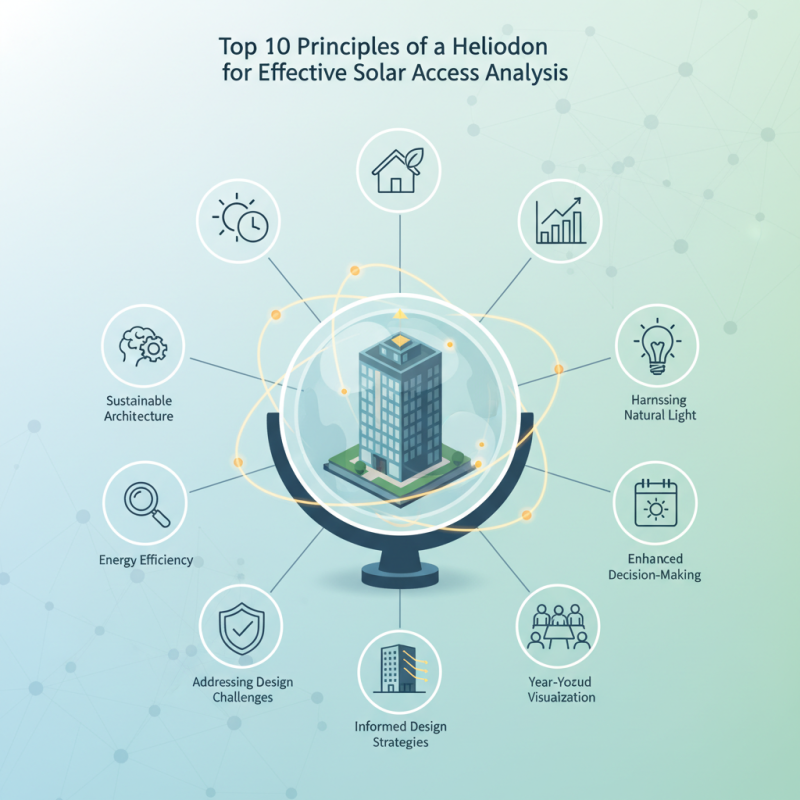
Top 10 Principles of a Heliodon for Effective Solar Access Analysis?
In the realm of solar access analysis, the "Principles of a Heliodon" stand as a vital framework. A heliodon is a tool that accurately simulates solar paths, revealing how sunlight interacts with buildings and landscapes. According to the renowned architect and environmental designer, Dr. Emma Collins, "Understanding solar access through a heliodon is essential for sustainable architecture." This statement resonates strongly with industry professionals as they strive to create energy-efficient designs.
Recent studies show that up to 40% of energy consumption in buildings can be influenced by effective solar access strategies. Utilizing the Principles of a Heliodon allows designers to visualize the sun's position throughout the year. This clarity enhances decision-making and leads to better designs that harness natural light, thereby reducing reliance on artificial lighting.
However, there are challenges. Many architects still overlook the potential of heliodons. This oversight may arise from a lack of understanding of solar analysis tools. Acknowledging these challenges is crucial for improving design practices. Implementing the Principles of a Heliodon can significantly enhance building performance and provide insights into effective solar access strategies.
Principle 1: Understanding Solar Path and Seasonal Variations in Sunlight
Understanding the solar path is vital for effective solar access analysis. Sunlight varies throughout the year. This variation is influenced by both the Earth’s tilt and its orbit. According to the National Renewable Energy Laboratory, solar energy can change by as much as 30% in different seasons. Accurate models can predict day-to-day changes and long-term trends.
Siting structures thoughtfully can optimize sunlight capture. Local climate impacts must be considered for effective design. For example, a building in a northern region may require different strategies than one in the tropics. Shadows from surrounding landscapes can obstruct sunlight during peak hours. Awareness of these factors can enhance energy efficiency.
Weather patterns and atmospheric conditions further complicate solar access. Cloud cover and pollution can significantly reduce available sunlight. A study from the Solar Energy Industries Association notes that some areas may experience up to 25% less solar output due to these issues. Therefore, it is essential to analyze historical weather data when evaluating solar potential. This analysis can guide more resilient and adaptive designs that respond to varying conditions.
Understanding Solar Path and Seasonal Variations in Sunlight
Principle 2: Integrating Geographic Location and Latitude into Design Analysis
Effective solar access analysis requires a thorough understanding of geographic location and latitude. Analyzing these factors early in the design phase is imperative. Latitude directly influences the sun's angle and its path throughout the year. Thus, it becomes a critical element in solar access studies.
Consider the design of a building in a high-latitude region versus one near the equator. The same structure in these different locations will experience variation in sunlight exposure. For instance, homes in northern locales might need larger windows facing south to maximize sun exposure during winter. Conversely, buildings in tropical areas must consider excessive heat from direct sunlight.
Tip: Always use local solar data. This data can reveal unique patterns in sun exposure. Engaging with local resources or solar mapping tools often yields insightful data.
Field observations can sometimes contradict data. Noticing how shadows play around your site during different seasons is vital. You may realize that trees or neighboring buildings create unexpected shading effects. Regularly revisiting the solar access conditions is essential for effective analysis. Adapt and refine your designs based on these observations.
Principle 3: Utilizing Accurate Scale Models for Realistic Shadow Studies
Using accurate scale models is crucial for effective shadow studies in solar access analysis. Scale models can replicate the building dimensions and their surroundings, offering a tangible way to visualize sunlight patterns. By manipulating the models in a controlled environment, analysts can observe how shadows move throughout the day. This method helps identify areas that may suffer from insufficient sunlight.
When creating a scale model, consider the material used. Some materials simulate light more effectively than others. For instance, transparent plastics can mimic how various surfaces interact with sunlight. Keep in mind that environmental variables, such as nearby trees or buildings, can affect results. Regularly revisit your assumptions about these factors.
Tips: Choose a scale that clearly represents the actual site. A 1:50 scale might work for small projects, but larger ones could require a different approach. Test shadows during different seasons to see seasonal changes. Be prepared to reassess the models if unexpected shadow patterns arise. The goal is to create a reliable model that provides insight into real-world scenarios. Use this technique to enhance the accuracy of your solar access analysis.
Top 10 Principles of a Heliodon for Effective Solar Access Analysis - Principle 3: Utilizing Accurate Scale Models for Realistic Shadow Studies
| Model Type |
Scale |
Material |
Shadow Accuracy |
Usage Frequency |
| Residential Building |
1:100 |
Wood |
High |
Weekly |
| Commercial Complex |
1:200 |
Plastic |
Medium |
Monthly |
| Park Layout |
1:500 |
Cardboard |
Low |
Bi-annual |
| Urban Development |
1:1000 |
Foam |
Medium |
Annually |
Principle 4: Employing Advanced Software Tools for Simulation and Data Analysis
Employing advanced software tools is crucial for effective solar access analysis. These tools allow architects and planners to simulate sunlight patterns and assess shade impacts accurately. Utilizing three-dimensional modeling can produce realistic representations of sunlight exposure throughout the year. According to a recent report by the International Energy Agency, optimizing solar access can lead to a 20% increase in energy efficiency in buildings.
However, relying solely on software isn’t always ideal. The accuracy of simulations depends on the input data. Inaccurate geographic or environmental data can misrepresent sunlight exposure. A study published in the Journal of Solar Energy Engineering noted that over 30% of simulated scenarios had discrepancies when compared to real-world measurements. Practitioners should validate results through physical testing when possible.
Moreover, the complexity of these tools can be a barrier. Training staff to use advanced software effectively is essential. A survey indicated that nearly 25% of users felt undertrained in utilizing these technologies. This skill gap could lead to misinterpretations. As the demand for sustainable designs increases, continuous learning is vital to stay ahead. Tools are powerful, but they require informed users who can critically evaluate their outputs.
Principle 5: Assessing Material Reflectivity and Surface Orientation in Designs
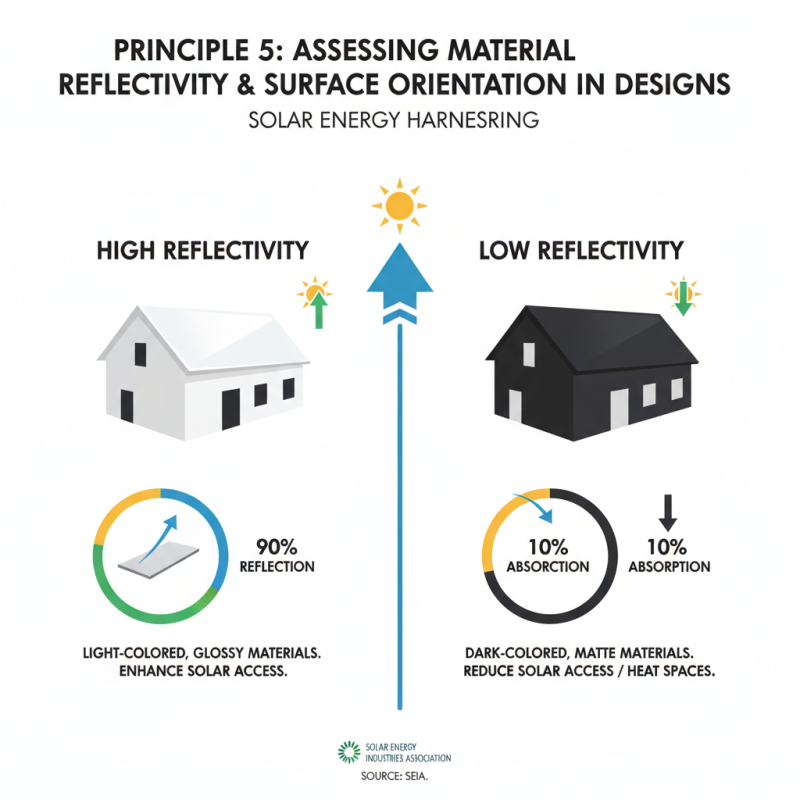
When designing any structure, assessing material reflectivity plays a crucial role. Reflective surfaces can significantly enhance or reduce solar access. According to the Solar Energy Industries Association, light-colored and glossy materials can reflect up to 90% of sunlight. In contrast, dark and matte surfaces absorb a large portion of solar radiation, which can heat up spaces unnecessarily.
Surface orientation is another critical factor. Orientation determines how sunlight interacts with building materials throughout the day. For instance, south-facing surfaces receive more direct sunlight in the northern hemisphere. This could lead to overheating if not managed properly. Reports from the National Renewable Energy Laboratory indicate that improper orientation can result in a 30% increase in cooling costs during peak summer months.
However, the ideal balance between reflectivity and surface orientation isn't easy to achieve. It requires a detailed analysis of the local climate and site characteristics. Designers need to consider how shadows from trees or nearby buildings might impact solar gain. It's not just a numbers game; material choices must align with overall design goals and environmental sustainability. Regular reviews of these decisions can foster improvement and ensure the design remains effective long-term.

 Sensor
 Measuring Instruments
 Measurement Systems
 Architectural Physics Laboratory