Leave Your Message

7 Best Heliodon Architecture Models for Global Buyers

Choosing a heliodon model is not simply a matter of size, appearance, or price. For global buyers, the right Heliodon Architecture tool must reveal how sunlight moves across a proposed building, site, and surrounding context. It should make shadows visible. It should also support reliable comparisons between seasons, latitudes, and design alternatives.

Le Corbusier wrote, “Architecture is the masterly, correct and magnificent play of masses brought together in light.” His words remain highly relevant to physical solar studies. A well-built heliodon turns that idea into something measurable, using adjustable light sources, scaled models, and clear shadow patterns. However, no model explains every climate condition perfectly. That limitation matters.

This guide examines seven leading Heliodon Architecture models for international buyers. The selection considers construction quality, solar-angle control, model capacity, portability, teaching value, and long-term maintenance. It also considers practical details, such as whether a small studio can store the unit safely or whether a university laboratory needs repeated daily demonstrations.

Some choices are obvious. Others are not.

A premium model may offer precise controls but exceed a modest project budget. A compact model may travel easily but limit large urban studies. Buyers should therefore evaluate their actual workflow, not only product specifications. This introduction is not a final verdict. It is a careful starting point, because field experience often exposes weaknesses that brochures leave out.
7 Best Heliodon Architecture Models for Global Buyers

Heliodon Architecture Models: Purpose, Principles, and Core Components

7 Best Heliodon Architecture Models for Global Buyers

Heliodon Architecture Models: Purpose, Principles, and Core Components

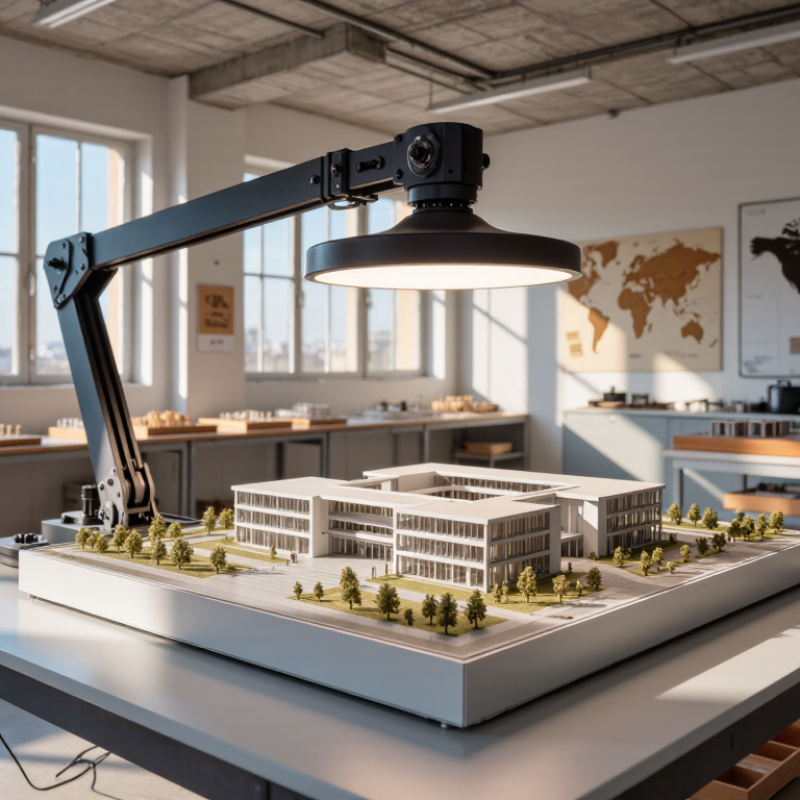
A heliodon architecture model shows how sunlight interacts with a building throughout the day and year. It helps architects study glare, shadow length, daylight access, and outdoor comfort before construction begins. In practice, a physical model can reveal problems that digital images sometimes hide. A narrow courtyard may appear bright on screen but remain shaded during winter mornings.

Its core principle is controlled solar simulation. The model sits on an adjustable platform, while a movable light source represents the sun’s changing position. Latitude, date, time, and orientation must be set accurately. Even a small rotation can alter the shadow pattern across a façade. Results should be checked against local climate data and the project’s actual site conditions.

Useful components include a detailed building model, a calibrated light source, an angle scale, and a stable base. Transparent materials can test glare near windows. Removable walls help compare ventilation and daylight strategies. Scale matters greatly. Poorly sized trees, balconies, or neighboring blocks may produce misleading shadows. The model is not an oracle. It supports judgment.

Experienced teams usually record each test with the date, solar angle, model scale, and observed shadow edge. This creates reliable evidence for design revisions and buyer evaluation. However, physical testing still has limits. Surface texture, artificial light, and simplified surroundings can affect results. A careful workflow combines model observations with measured calculations, not attractive images alone.

7 Best Heliodon Architecture Models for Global Buyers — Heliodon Architecture Models: Purpose, Principles, and Core Components
Model Type Best Application Sun-Path Principle Typical Adjustable Variables Core Components Main Evaluation Output Global Buyer Considerations
Fixed-Latitude Seasonal Heliodon Early-stage testing of building orientation, massing, and façade proportions at a selected site latitude. Uses a fixed geographic latitude while the physical model rotates through solar positions for different dates and times.
  • Solar altitude and azimuth
  • Model orientation
  • Season and time of day
Adjustable sun source, latitude frame, rotating model platform, scale model, and shadow screen. External shadow length, façade exposure, courtyard shading, and seasonal sun penetration. Suitable when the project location is known and a simple, repeatable physical setup is preferred.
Adjustable-Latitude Heliodon Comparing projects located in different climate zones or testing several site options. Changes the angle between the solar path and the model to represent different geographic latitudes.
  • Latitude setting
  • Solar altitude
  • Solar azimuth
  • Building orientation
Latitude adjustment mechanism, calibrated sun arc, rotating base, angle scales, and architectural model. Comparative performance of the same design under different geographic conditions. Useful for international design teams because one apparatus can support multiple site studies.
Rotating-Model Heliodon Studying orientation, street-canyon effects, courtyard layouts, and urban block relationships. The light source remains positioned along a defined solar path while the model rotates to simulate changing building orientation.
  • Model rotation angle
  • Solar date and time
  • Street or block geometry
Rotating turntable, degree markings, movable model platform, light source, and shadow-capture surface. Shading of adjacent buildings, public spaces, streets, and building openings. Practical for physical urban design reviews where direct visual comparison is important.
Mobile-Light-Source Heliodon Detailed façade, window, balcony, canopy, and interior daylight investigations. Moves a directional light source along a controlled arc to reproduce different solar altitudes and azimuths.
  • Light-source position
  • Beam direction
  • Model orientation
  • Time and season
Track or articulated arm, directional lamp, position scale, model platform, and optional photographic background. Sunlight access, self-shading, glare risk indicators, and penetration through openings. Offers flexible testing but requires careful calibration and a stable, low-glare light source.
Mirror-Assisted Heliodon Compact laboratories, classrooms, and projects requiring a longer effective solar path within limited space. Uses reflective surfaces to redirect the light path while maintaining a controlled relationship between source, model, and solar angle.
  • Mirror angle
  • Solar altitude
  • Model rotation
  • Reflective surface position
Light source, calibrated mirrors, mounting frame, rotating model table, angle scales, and shadow screen. Directional shadow behavior and relative sunlight exposure in constrained testing environments. Space-efficient, but reflective surfaces must remain clean and accurately aligned for reliable results.
Solar-Arc and Sun-Path Diagram Model Teaching solar geometry and communicating design decisions during concept development. Combines a physical model with altitude and azimuth arcs representing the apparent movement of the sun.
  • Latitude
  • Seasonal date
  • Solar time
  • Model orientation
Sun-path chart, latitude scale, model platform, directional pointer, shadow plane, and reference grid. Relationship between solar position, building form, orientation, and shading strategy. Best for transparent workshops and presentations where users need to understand the governing principles.
Hybrid Physical-Digital Heliodon Design reviews that combine physical model observation with digital solar data and documentation. Uses a physical light-and-model arrangement alongside digital sun-position calculations or time-stamped image records.
  • Latitude and longitude
  • Date and time
  • Orientation
  • Model scale
  • Camera position
Physical heliodon, scale model, calibrated lighting, camera or sensor, digital sun-path reference, and recording system. Visual shadow studies supported by traceable solar angles, comparison images, and design-review records. Suitable for international coordination, provided the physical setup and digital calculations use consistent coordinates and time conventions.
Selection should be based on project latitude, required accuracy, model scale, available testing space, portability, and whether the study focuses on urban massing, façade design, daylight access, or design education.

Key Features to Compare in Heliodon Models for Global Buyers

Choosing among the 7 best Heliodon architecture models requires more than comparing prices. Global buyers should examine sun-path accuracy, adjustable latitude settings, and light-source stability. A reliable model should simulate seasonal sunlight across different regions. Check whether the scale supports detailed façade, window, and shading studies. Small errors can distort shadow measurements.

Construction quality matters during repeated demonstrations. Look for a rigid frame, smooth rotation, clear angle markings, and a secure model platform. LED lighting usually produces less heat and supports longer sessions. However, brightness alone is not enough. Ask for calibration data, operating instructions, replacement-part information, and test results. Power compatibility is also important for international use. I have seen attractive models become frustrating when their controls feel loose or documentation is incomplete.

Tips: Request a live demonstration before ordering. Compare shadow edges at morning, noon, and late afternoon positions. Confirm the model’s latitude range and maximum building size. Review packaging details, especially for long-distance transport. Do not ignore setup time. A technically advanced model may still perform poorly in a busy classroom or design studio. No model is perfect. Buyers should record their main research needs and test each feature against real project conditions. Independent user feedback can reveal practical weaknesses that specification sheets often miss.

Seven Leading Heliodon Model Types and Their Practical Applications

7 Best Heliodon Architecture Models for Global Buyers

Seven Leading Heliodon Model Types and Their Practical Applications

A heliodon simulates sunlight across a building model, site, or façade. It supports early decisions about orientation, shading, and seasonal comfort. The seven leading types serve different study needs. A fixed-axis heliodon suits quick classroom demonstrations. A rotating-disk model tests daily sun movement. An adjustable-latitude model supports projects across different climates. A shadow-box heliodon reveals interior daylight penetration. A façade-section model examines louvers, balconies, and window depth. A physical site heliodon studies nearby buildings and trees. A digital or hybrid heliodon adds precise solar-angle analysis.

These tools have practical value. The UNEP 2023 Global Status Report states that buildings created about 37% of global energy-related and process-related emissions in 2022. Small orientation errors can therefore create costly design consequences. A rotating-disk model can expose morning glare on east-facing glazing. A façade model can show why a narrow overhang fails during low winter sun. A site model can reveal shadows across a courtyard or rooftop garden. Physical testing remains useful when clients need visible evidence, not only software screenshots.

No model is perfect. Physical heliodons simplify cloud cover, reflective surfaces, and local weather. Digital models may miss construction tolerances or material aging. That limitation deserves review. Designers should compare model observations with regional climate files and measured daylight data. The International Energy Agency also identifies buildings as a major global energy user, reinforcing the need for careful solar planning. For global buyers, the most reliable choice is often a modular system with adjustable latitude, interchangeable scales, and clear calibration records.

How to Evaluate Size, Materials, Lighting, and Simulation Accuracy

7 Best Heliodon Architecture Models for Global Buyers

How to Evaluate Size, Materials, Lighting, and Simulation Accuracy

Choosing a heliodon model requires more than checking its appearance. The seven strongest options usually include compact desktop units, modular systems, adjustable solar paths, and full-scale teaching models. Start with size. Measure the usable platform, model height, and viewing distance. A small unit suits apartment studies, while larger platforms reveal shadows across courtyards and roof forms. Confirm the scale ratio before comparing results. A model can look precise and still mislead.

Materials affect both durability and visual clarity. Rigid boards, acrylic panels, and lightweight composite surfaces should resist warping under repeated handling. Transparent parts must remain clear after cleaning. Check how easily the model accepts removable walls, trees, and surrounding buildings. I prefer replaceable components because real design studies change often. Still, modular joints may introduce small gaps. That flaw needs documentation, not concealment.

Lighting performance deserves careful testing. The system should reproduce solar angles for different latitudes, dates, and times. Verify the light source with a known shadow length, then compare it with a calculated result. Watch for uneven brightness, harsh glare, or shadows softened by unintended reflections. Record each setting with photographs and measurements. Software simulation can support the physical test, but it should not replace it. A convincing image is not proof of accuracy. Ask for calibration records, operating instructions, and independent test evidence. Global buyers should also check voltage compatibility, spare parts, training, and shipping protection. Small details matter.

Buying Considerations: Customization, Shipping, Safety, and Support

7 Best Heliodon Architecture Models for Global Buyers

Buying Considerations: Customization, Shipping, Safety, and Support

The best heliodon architecture model should match your studio’s teaching goals, scale, and available space. In practical evaluations, adjustable sun paths often reveal more than attractive finishes. Check whether the unit supports your project latitude, seasonal angles, and selected model scale. Custom options may include larger platforms, metric markings, movable lamps, and regional power requirements. Fit matters. Ask for drawings before ordering.

Shipping can decide whether a good model arrives usable. Request a reinforced crate, internal padding, moisture protection, and clear handling instructions. Confirm delivery terms, customs documents, insurance, and replacement procedures before payment. A shock indicator is useful, but it cannot prevent hidden damage. I once underestimated the space needed for an oversized base. That mistake made installation slower than expected.

Safety deserves practical attention, especially in classrooms and shared studios. Look for guarded lamps, stable supports, heat management, grounded components, and clear operating instructions. Require relevant test documents for the destination market. Support should include setup guidance, calibration advice, spare parts, and a written warranty. Remote training can help, but a short video may not answer every technical question. Document everything. A responsive service team matters when a lamp fails before a presentation.