How to Choose the Best Temperature and Humidity Sensor?
Choosing the right Temperature and Humidity Sensor can greatly impact your project. Whether you are monitoring a greenhouse, home, or industrial setting, these sensors play a crucial role. They help maintain optimal conditions for plants or sensitive equipment.
When selecting a Temperature and Humidity Sensor, consider accuracy, range, and response time. Some sensors may not provide the precision you need. Others might have a limited range, which can affect their performance in certain environments. Look for sensors that offer reliable data and meet your specific requirements.
Don’t overlook the importance of durability and ease of installation. While some sensors are easy to set up, others can be complicated. Think about where you will place the sensor. Ensure it can withstand the conditions it will face. The right choice can lead to better results, while a poor one may cause frustration. This decision deserves careful thought.
Understanding the Basics of Temperature and Humidity Sensors
Understanding temperature and humidity sensors is crucial in many applications. These devices measure environmental conditions, providing data that can influence decisions. A temperature sensor detects heat levels, while a humidity sensor gauges moisture in the air. They often work together to give a full picture of an environment.
When choosing a sensor, consider accuracy and response time. Some sensors may provide readings that fluctuate. It’s important to find one that you can trust. Calibration is also vital; poorly calibrated sensors can create misleading data. Look for models that allow for adjustment.
Installation location matters too. A sensor placed too close to heat sources can give false readings. Conversely, one hidden in a corner may not capture true conditions. Always evaluate your setup. Environmental factors can change sensor performance significantly. There’s room for improvement in many selections and placements. Choosing the best sensor requires careful thought and continuous evaluation.
Types of Temperature and Humidity Sensors Available in the Market
When selecting a temperature and humidity sensor, understanding the types available is crucial. There are several primary categories. Capacitive sensors are popular for their accuracy and quick response times. They measure changes in capacitance caused by humidity variations. Data from the market shows a projected CAGR of 8.4% for this segment over the next five years.
Resistive sensors, on the other hand, operate by altering resistance in response to humidity levels. They are generally more affordable but may not provide the same performance as capacitive types. Studies indicate they hold around 30% of the market share, suggesting they are widely used but sometimes less reliable in extreme conditions.
Thermal conductivity sensors are another option. They provide precise measurements in specific applications, including HVAC systems. However, their complexity can lead to maintenance challenges. This makes them less ideal for casual users or non-experts. Understanding these differences can guide consumers to better choices, though many still overlook their specific needs.
Temperature and Humidity Sensor Types Comparison
This chart compares the accuracy of different types of temperature and humidity sensors available in the market. Understanding the accuracy of each sensor type can help you make an informed decision when selecting the right sensor for your needs.
Key Features to Consider When Choosing a Sensor
When choosing a temperature and humidity sensor, several key features can significantly impact performance. Accuracy is crucial; look for sensors with a high degree of precision. A small margin of error can make a big difference in environments like greenhouses or laboratories. Durability also matters. Consider sensors designed for specific conditions, whether they’re exposed to harsh environments or simply need longevity.
Another important feature is response time. Some sensors may take longer to adjust to changes. This could lead to inaccurate readings. You'll want a sensor that reacts quickly to fluctuating conditions. Ease of installation and use is also vital. A complicated setup can be frustrating and may deter proper monitoring.
Connectivity features should not be overlooked. Some sensors offer wireless options for easier data collection. However, the complexity of connectivity can lead to issues. Always think through how data will be accessed and analyzed. In rooms with poor signal reception, wireless sensors may struggle. Assess your unique environment carefully to avoid disappointments.
How to Choose the Best Temperature and Humidity Sensor? - Key Features to Consider When Choosing a Sensor
| Feature |
Description |
Importance |
| Temperature Range |
The range of temperatures that the sensor can measure, typically in Celsius or Fahrenheit. |
Critical for applications requiring specific temperature monitoring. |
| Humidity Range |
The acceptable level of humidity the sensor can detect, usually given as a percentage. |
Essential for environments sensitive to humidity levels. |
| Accuracy |
The degree to which the sensor's readings reflect the actual temperature and humidity. |
A high accuracy ensures reliable data for critical operations. |
| Response Time |
The time it takes for the sensor to respond to changes in temperature or humidity. |
Faster response times are crucial in dynamic environments. |
| Output Signal |
The type of signal the sensor uses to communicate (e.g., analog, digital, wireless). |
Determines compatibility with your monitoring system. |
| Power Supply |
The type of power source the sensor needs (e.g., battery, AC, or DC). |
Important for setup considerations and ongoing maintenance. |
| Calibration |
The process of adjusting the sensor to ensure accurate readings. |
Regular calibration is essential for maintaining accuracy over time. |
| Mounting Options |
The various ways the sensor can be installed (e.g., wall-mounted, portable). |
Flexibility in installation can be crucial for certain applications. |
Assessing Accuracy and Calibration for Reliable Measurements
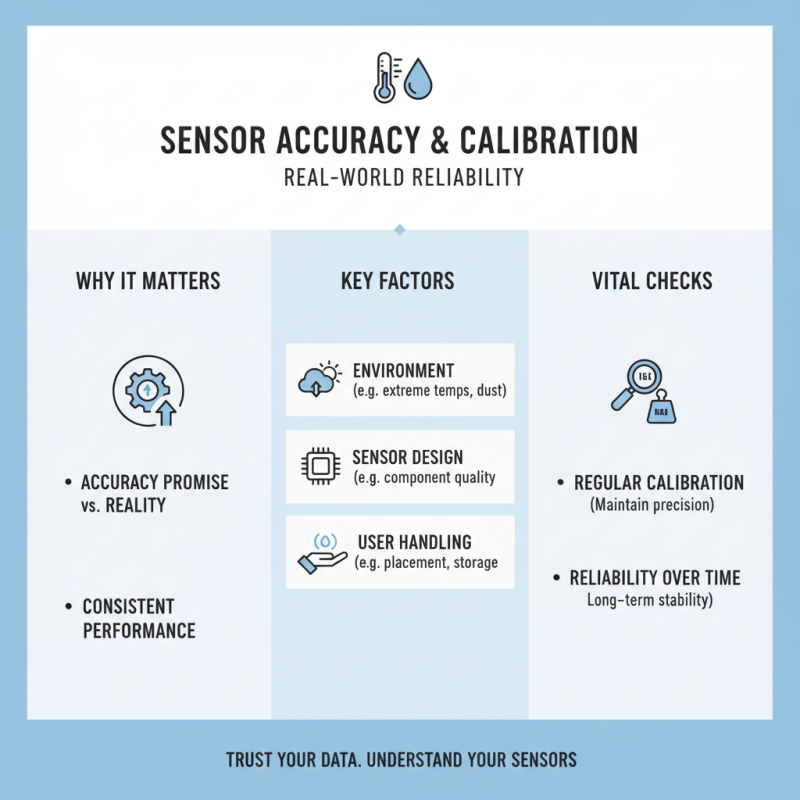
When assessing temperature and humidity sensors, accuracy and calibration are vital. A sensor may promise high precision, but how reliable is it in real-world conditions? Many factors can affect accuracy. Environmental conditions, sensor design, and even user handling play a role.
Calibration is often overlooked. New sensors may come pre-calibrated, but this can drift over time. Regular re-calibration is necessary for true reliability. Consider using standardized reference points. Testing devices in controlled environments can reveal inconsistencies. It’s common to receive results that vary from expected values, prompting a deeper look into the calibration process.
In practice, you might find sensors that are easy to use but not the most accurate. Small errors can lead to significant problems in practical applications. Reflect on your needs. Are you prioritizing ease of use over precise readings? Understanding this balance is crucial to making an informed choice.
Evaluating Sensor Compatibility with Your Application Needs
When selecting a temperature and humidity sensor, compatibility with your specific application is crucial. Recent industry reports indicate that approximately 70% of sensor failures stem from incompatibility issues. Factors like measurement range, accuracy, and response time are vital. Sensors should align tightly with the environment in which they operate. For instance, a sensor in a greenhouse will face different conditions than one in a data center.
Consider the environment. For indoor applications, typical humidity levels range from 40% to 60%. If the sensor can't handle a wider span, it might deliver inaccurate readings. Another study shows that 55%% of professionals cite accuracy as the most significant factor when choosing sensors. Thus, evaluating specifications is essential. High accuracy is often prioritized over lower costs, especially in critical applications.
It's also worth noting that installation and maintenance requirements can differ significantly. Some sensors require calibration, while others operate accurately out of the box. Roughly 45% of users reported issues due to improper setup. These realities highlight the importance of thoroughly understanding your needs. Careful evaluation helps in avoiding costly mistakes later on.

 Sensor
 Measuring Instruments
 Measurement Systems
 Architectural Physics Laboratory